


250L vs 800L vs 1000L chemical IBCs
Compare reusable VARIBOX Compact, Full and Single Containment configurations by nominal volume, dispensing method, chemical suitability and the actual operating requirements of your site.

Safer

Reusable

Sustainable
What matters when choosing your IBC capacity?
A useful comparison starts with the available VARIBOX family—not an assumption that every model has the same discharge or containment system.

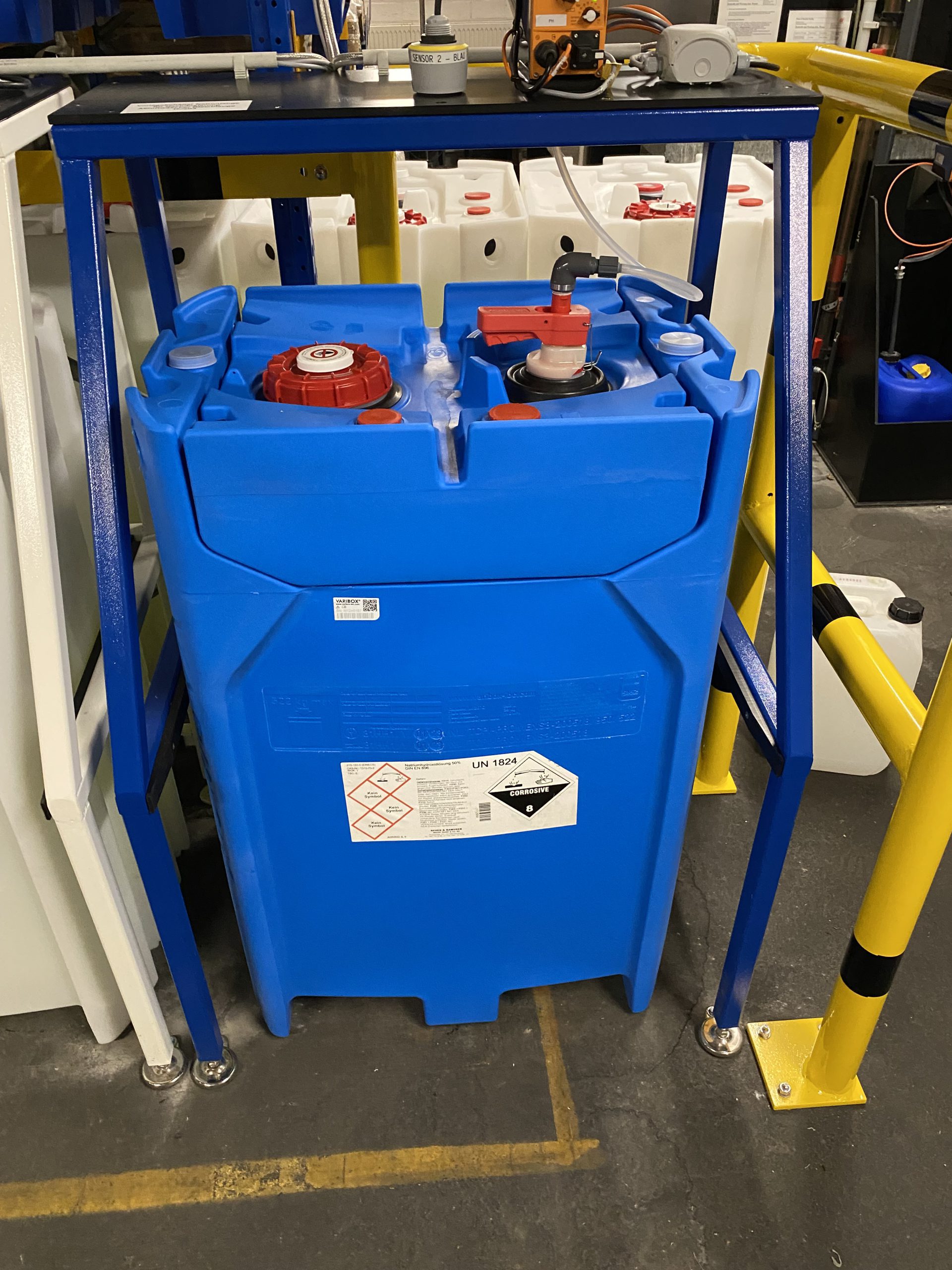
250-litre format
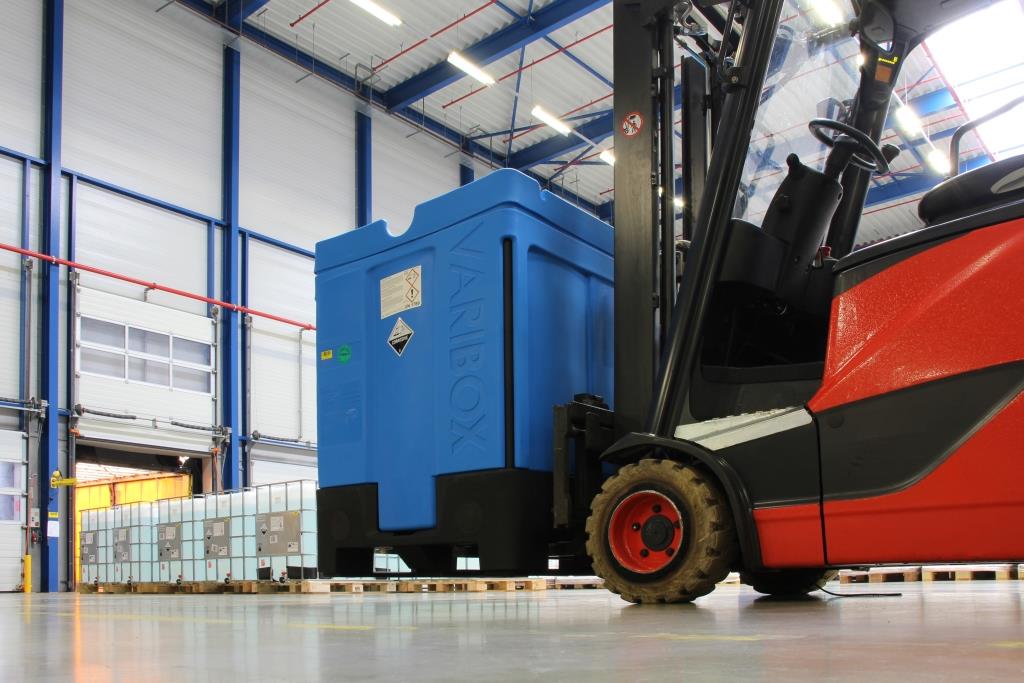
800 and 1000 litres

Application first
SIDE-BY-SIDE
Comparison of VARIBOX chemical IBC formats
| Criterion | 250L | 800L | 1000L |
|---|---|---|---|
| Family | Compact Containment (CC) | Full Containment (FC) / Single Containment (SC) | Full Containment (FC) / Single Containment (SC) |
| Nominal capacity | 250 litres | 800 litres | 1000 litres |
| Integrated secondary containment | In the CC design | In the FC design, not inherently the SC arrangement | In the FC design, not inherently the SC arrangement |
| Withdrawal concept | Suitable top-extraction options | FC top-withdrawal / SC heavy-duty bottom valve | FC top-withdrawal / SC heavy-duty bottom valve |
| Site fit | Check compact footprint and smaller supply needs | Check model-specific dimensions and handling space | Check model-specific dimensions and handling space |
| Chemical suitability | Verify approval and wetted components | Verify approval and wetted components | Verify approval and wetted components |
Application note. Physical dimensions, tare weights, filling limits, handling requirements and permissible chemicals depend on the actual product model and revision.
CHOOSE THE SIZE
Four decisions before specifying an IBC
01 / CHEMICAL
Verify the substance
Check the exact SDS, density, concentration, temperature and current product approval.
02 / CAPACITY
Plan consumption
Estimate what the process uses per day or shift and how frequently packaging is delivered or exchanged.
03 / SITE
Check handling
Confirm access routes, doors, forklifts, lifting and storage layout for the precise container.
04 / DISPENSE
Choose the connection
Decide whether a controlled top-withdrawal connection or a heavy-duty bottom valve is appropriate.
THE PRODUCT DIFFERENCE
Full Containment versus Single Containment at 800L and 1000L
VARIBOX FC and SC are different packaging concepts, even when the nominal capacity is the same. FC is developed around a double-walled integrated-containment design and suitable top withdrawal; SC is a reusable bottom-valve IBC for relevant applications.
Full Containment
Consider containment design, access for an extractor tube, the complete connected process and approvals.
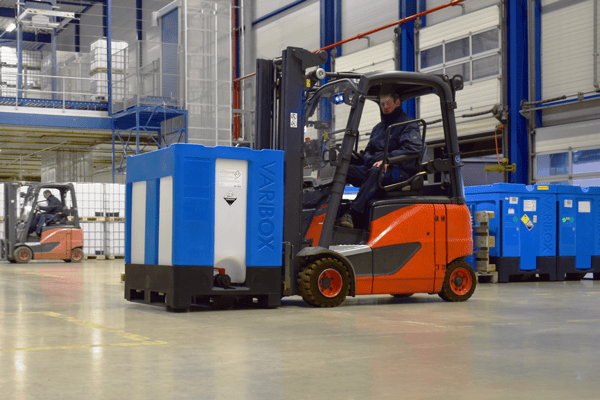
Single Containment
Consider the heavy-duty ball valve, the outlet position, the receiving system and any external protective measures.
CONNECTION AND APPLICATION
Choose the IBC and the dispensing interface together
For compatible configurations, VARIBOX Safeline is an extractor-tube/coupler solution. VARIBOX Single Containment instead uses a heavy-duty bottom valve. Neither the connection nor the nominal size determines dosing accuracy; the external process equipment does.
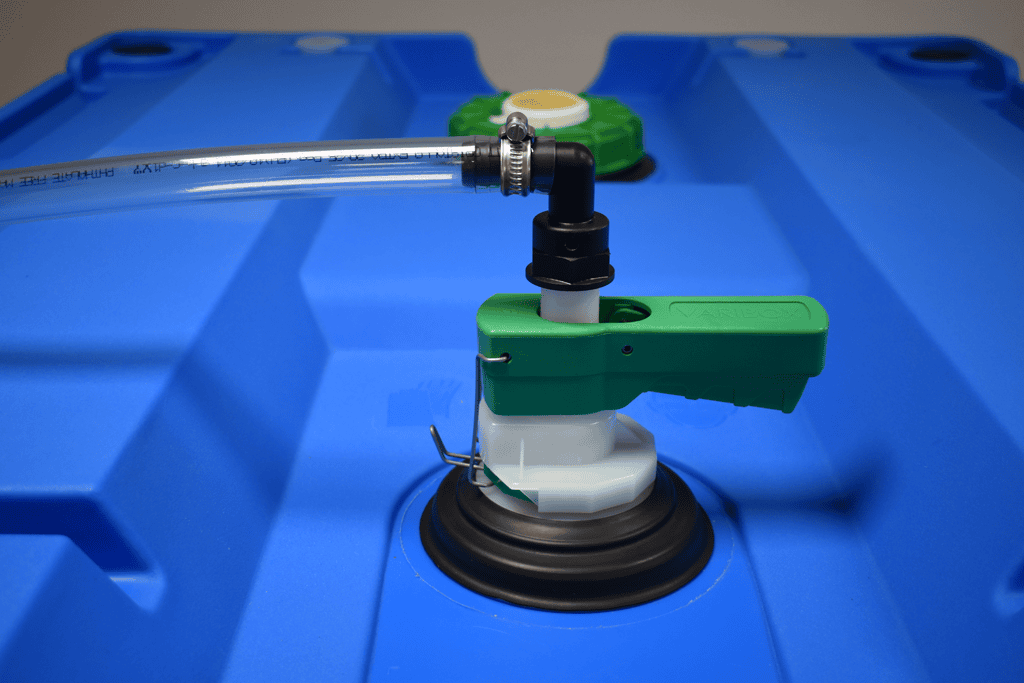
Top withdrawal
A matching coupler and extraction assembly can support a defined withdrawal procedure.

Bottom valve
Plan the valve, hose connection, operating access and any necessary site containment.
REQUEST A CORRECT SPECIFICATION
What we need to select an IBC
- The product name, exact formulation, SDS and concentration.
- Nominal amount and required supply interval.
- Whether integrated secondary containment is relevant to the site.
- The planned outlet, coupler, pump and expected flow.
- Actual handling and space limits, inspection and return arrangements.
Do not use a generic dimensions chart as a substitute for the current VARIBOX drawing and product approval.
CAPACITY IN PRACTICE
How volume affects deliveries and container changeovers
Choosing between a 250-, 800- and 1000-litre IBC means considering the rhythm of chemical consumption. A smaller package may suit intermittent demand or smaller dosing points, while a larger package may reduce the frequency of container exchange in a suitable installation. Those are conditional effects, not guarantees.
Supply and consumption pattern
Estimate the actual amount required between planned deliveries and the time available to change packaging. Consider minimum and maximum process demand, the ability to position a new IBC and whether the operation requires uninterrupted supply. A nominal size comparison without these details gives an incomplete recommendation.
Physical constraints
Check the actual dimensions and weight of the approved VARIBOX model with the current technical drawing. Doorways, forklifts, surface loading, storage arrangements and access to the outlet may rule out a format that looks suitable on paper. Different models with the same nominal capacity are not necessarily interchangeable.
Selecting the correct size should result in a documented specification of container, chemical, physical access, dispensing interface and return procedure.
FC OR SC
The same nominal volume can use a different dispensing concept
VARIBOX’s larger-size options include Full Containment and Single Containment concepts. They differ by construction and by how the liquid is typically taken out of the IBC. That makes the product family as important as the size number.
Full Containment and top withdrawal
An appropriate VARIBOX FC configuration has a double-walled integrated containment concept and can work with a suitable extractor tube and matching coupling. The external pumping system, chemical compatibility and site requirements must be assessed as a whole. Integrated containment should never be treated as an automatic exemption from site-specific safeguards.
Single Containment and a bottom valve
VARIBOX SC provides a heavy-duty valve at the lower outlet in the relevant configuration. The operator must consider valve access, safe disconnection, hose design, accidental release risk and the site’s protective measures. A matching valve fitting is only one part of a correctly engineered process.
See the FC range and the SC range before comparing prices or creating a size standard.
SELECT, VERIFY, THEN ORDER
An IBC size selection worksheet for your team
When several products or departments use the same site, a standardised choice is attractive. But a common package is only useful if the underlying chemical and operational requirements remain compatible. Use the following checklist before requesting a final VARIBOX model.
Questions for procurement
What chemical will be filled, what volume does each delivery require and how will the container be received? Does the site need 250, 800 or 1000 litres, and is the proposed pack intended for reusable distribution? Are current transport and storage conditions understood?
- Product, concentration, density and temperature.
- Actual model and approval documentation.
- Delivery frequency and return programme.
Questions for operations
How will product be withdrawn? What space is available for handling and connecting? Does the plant have suitable pumping equipment, a bottom-outlet connection or an approved top-withdrawal routine? Who checks the container before and after use?
- Site drawing and mechanical handling constraints.
- Process connection and required flow.
- Operator instructions and inspection responsibilities.
A VARIBOX representative can use this worksheet to narrow the product range, after which the site and technical specialists must validate the proposed configuration.
COMMON QUESTIONS
Frequently asked questions
Does VARIBOX offer both 800 and 1000 litre IBCs?
Existing VARIBOX product information describes 800- and 1000-litre options within Full Containment and Single Containment. Confirm current specifications for the intended application.
What is the main difference between CC 250 and FC 800?
Both belong to double-walled containment-oriented product families, but they differ in nominal volume and precise product configuration.
Is a 1000L IBC always the most efficient?
No universal conclusion is possible. Consumption, delivery, physical site restrictions, transport and return arrangements all influence the choice.
Does every VARIBOX IBC have a bottom valve?
No. Single Containment uses a heavy-duty bottom valve; Full and Compact Containment use different connection concepts.
Which VARIBOX IBC size is right for your operation?
Share the liquid, desired capacity, site limitations and dispensing method. The team can review the suitable 250L, 800L and 1000L options.