


Bisphenol A (BPA)
Bisphenol A (BPA) is one of the most tightly regulated substances in food-contact materials. Here’s what it is, how the EU regulates it, and where VARIBOX reusable IBCs stand. VARIBOX containers are already in daily use across the food and beverage industry, and some of our largest customers in the chemical and detergent industries use VARIBOX packaging to deliver their products into that sector. Material safety in a food-contact context isn’t a new consideration for us; it’s one we’ve been designing around from the start.

Safer

Reusable

Sustainable
What is BPA?
Bisphenol A (BPA) is an industrial chemical used mainly to make polycarbonate plastics and epoxy resins, for example in some bottles, food can linings and certain protective coatings. It is not used to produce the polyethylene (PE) that VARIBOX IBCs and Rotovia containers are made from. BPA has attracted regulatory attention because small amounts can migrate from packaging into food, and health authorities have progressively lowered the exposure level they consider safe.

How does the EU regulate BPA?
BPA is regulated under the EU’s Food Contact Materials (FCM) framework, a different legal track from the Packaging and Packaging Waste Regulation (PPWR, Reg. (EU) 2025/40). PPWR governs packaging design, recyclability and reuse; FCM rules govern which substances are allowed to come into contact with food. Regulation has tightened in stages: BPA was banned in polycarbonate baby bottles in 2011, migration limits for BPA in varnishes and coatings were reduced to 0.05 mg/kg in 2018, and a 2023 EFSA safety re-evaluation led to a sharply lower Tolerable Daily Intake. The direction of travel is clear: the EU is moving toward eliminating BPA from food-contact materials altogether, not just capping how much may migrate.
Where do VARIBOX products stand?
VARIBOX IBCs are manufactured from PE, a polyolefin that does not require BPA or bisphenol-based additives in its production, unlike polycarbonate or epoxy-lined materials. Because BPA is not a raw material or processing aid in our resin system, it is not added during the manufacturing of VARIBOX containers and is not a source of BPA migration in the way polycarbonate or epoxy-lined packaging can be.
A closer look at the regulatory timeline
| Year | Development |
|---|---|
| 2011 | BPA banned in polycarbonate baby bottles (Directive 2011/8/EU) |
| 2018 | Migration limit for BPA in varnishes and coatings on food-contact materials reduced to 0.05 mg/kg (Commission Regulation (EU) 2018/213) |
| 2023 | EFSA re-evaluates BPA and sharply lowers the Tolerable Daily Intake (TDI), citing immune-system effects at low exposure |
| 2024–2026 | EU moves toward a broader restriction on BPA in food-contact materials, following the EFSA opinion, with transitional provisions for stock already in circulation |
Regrettable substitution: why “BPA-free” alone isn’t the full answer
When BPA came under regulatory pressure, some manufacturers switched to close chemical relatives, bisphenol S (BPS) and bisphenol F (BPF), which are structurally similar and, according to a growing body of research, may carry some of the same biological concerns. A material can legitimately be labelled “BPA-free” while still containing a substitute with an unresolved safety profile. This is one reason VARIBOX doesn’t rely on bisphenol chemistry at all: our HDPE resin system doesn’t require BPA, BPS, or BPF as a starting point, so there’s no substitution question to manage in the first place.
Reuse, migration and material choice
Migration risk is a function of the material, the contact time and the number of use cycles. Single-use or short-life packaging that relies on epoxy linings or polycarbonate components carries a migration profile that regulators revisit as usage patterns change. A reusable PE IBC, cleaned and reused across many cycles, is built on a resin chemistry that doesn’t introduce that same category of risk to begin with, which is part of why reusable packaging is increasingly positioned as the more resilient choice as food-contact rules tighten.
Have a technical or compliance question specific to your application?
Get in touch with our team for BPA declarations, food-contact documentation or migration test data.
BPA topics explained
Common questions on BPA and food-contact compliance, and where VARIBOX stands on each, expand any topic for more detail.
Is BPA banned in the EU?
BPA is now banned across nearly all food-contact materials in the EU under Commission Regulation (EU) 2024/3190, following a 2023 EFSA re-evaluation that found health risks at far lower exposure levels than previously assumed. A small number of specific technical applications retain longer transition periods due to a current lack of alternative materials, but the regulatory direction is a full phase-out rather than tightened migration limits.
Does BPA regulation apply to VARIBOX IBCs?
Yes. As an EU food-contact material product, VARIBOX is subject to the FCM framework, including the BPA restriction. VARIBOX IBCs are made from PE, not the polycarbonate or epoxy-based materials associated with BPA, so there is no BPA or bisphenol-based additive used in production, meaning compliance is straightforward rather than something achieved through an exemption.
Is this the same as PPWR compliance?
No. PPWR governs packaging design, recyclability and reuse. BPA sits under separate EU food-contact material rules. A product can be PPWR-ready and separately need to address food-contact substance rules; the two are assessed independently.
Are VARIBOX products food-grade?
VARIBOX is available in Food versions meeting the relevant requirements of Regulation (EU) No 10/2011 and Article 3, 11(5), 15 and 17 of Regulation (EC) No 1935/2004, both as amended, and complies with Regulation (EU) 2024/3190 on the use of bisphenol A (BPA). When used as specified, the overall migration as well as the specific migration do not exceed the legal limits.
Does recycled polyethylene affect BPA risk?
BPA is not part of PE resin chemistry, so using recycled PE doesn’t introduce a BPA pathway. Recycled-content material is still subject to food-contact suitability requirements, in the EU this falls under Regulation (EU) 2022/1616 on recycled plastic materials and articles intended for food contact, applied in the same way as for virgin resin.
How is compliance tested or certified?
Migration testing for food-contact materials follows EU-harmonised methods under Regulation (EU) 10/2011, typically the EN 1186 test series, carried out by ISO 17025-accredited third-party laboratories.
How does this relate to REACH?
BPA is also restricted under REACH (Regulation (EC) 1907/2006) for certain uses beyond food contact, such as thermal paper. The food-contact rules described on this page sit alongside, not instead of, REACH obligations.
Glossary
- BPA (Bisphenol A) — An industrial chemical historically used to make polycarbonate plastics and epoxy resins, now subject to strict EU restrictions in food-contact materials.
- PE (Polyethylene) — The polyolefin plastic used to manufacture VARIBOX IBCs, which does not contain or require BPA or bisphenol-based additives.
- FCM (Food Contact Materials) — The EU regulatory category covering any material or article intended to come into contact with food, including packaging, containers and coatings.
- EFSA (European Food Safety Authority) — The EU scientific body responsible for assessing food-related health risks, including the 2023 re-evaluation that led to stricter BPA rules.
- Migration limit — The maximum permitted amount of a substance allowed to transfer from a food-contact material into food.
- TDI (Tolerable Daily Intake) — The estimated amount of a substance a person can consume daily over a lifetime without appreciable health risk, as set by EFSA.
- Regulation (EU) 2024/3190 — The EU regulation banning BPA in nearly all food-contact materials, with limited transition periods for specific technical applications.
- Regulation (EU) 10/2011 — The core EU regulation governing plastic materials and articles intended for food contact requirements.
- REACH (Registration, Evaluation, Authorisation and Restriction of Chemicals) — The overarching EU regulation (EC No 1907/2006) governing the safety of chemical substances.
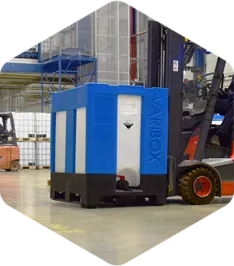
Our VARIBOX Intermediate Bulk Containers
We provide packaging for chemical distribution that excels in safety, reusability, and sustainability.
VARIBOX
Single Containment

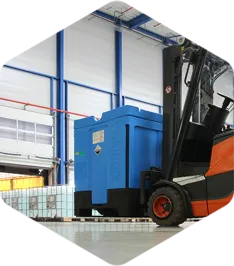
VARIBOX
Full Containment
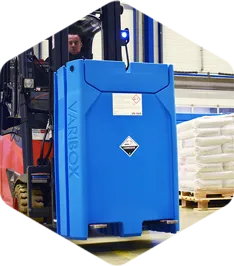
VARIBOX
Compact Containment
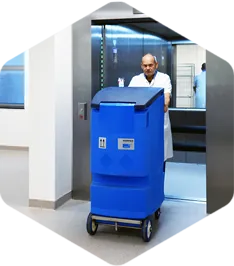
VARIBOX
Drumtainer

Connect+
Full control of your IBC fleet with real time tracking and insights. Pack AI provides an intelligent solution for the reusable packaging industry comprising both hard and software that allows you to achieve maximum control, minimal loss, and a longer lifespan for your IBC fleet.