


Food contact
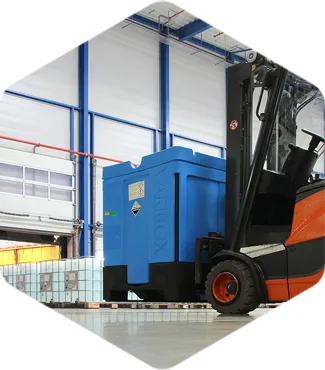
Moving food-grade liquids in bulk brings a separate compliance question alongside PPWR and BPA: is the packaging itself safe for repeated food contact? Here’s what that means in practice, and where VARIBOX Food versions stand. VARIBOX FC containers are already in daily use across the food and beverage industry, backed by a documented Declaration of Compliance covering migration testing, manufacturing conditions and the substances used in the product.

Safer

Reusable

Sustainable
What “food-grade” actually requires
A food-grade IBC has to demonstrate two things: that the overall migration from the container into food is within the overall legal limit (OML), and that any individually restricted substance stays under its own specific migration limit (SML). VARIBOX FC with EPDM Food seals is tested and declared against Regulation (EU) No 10/2011 and Regulation (EC) No 1935/2004 (Articles 3, 11(5), 15 and 17), both as amended, and against Regulation (EU) 2024/3190 on Bisphenol A. Meeting both the overall and the specific limits, not one or the other, is what the declaration actually certifies.
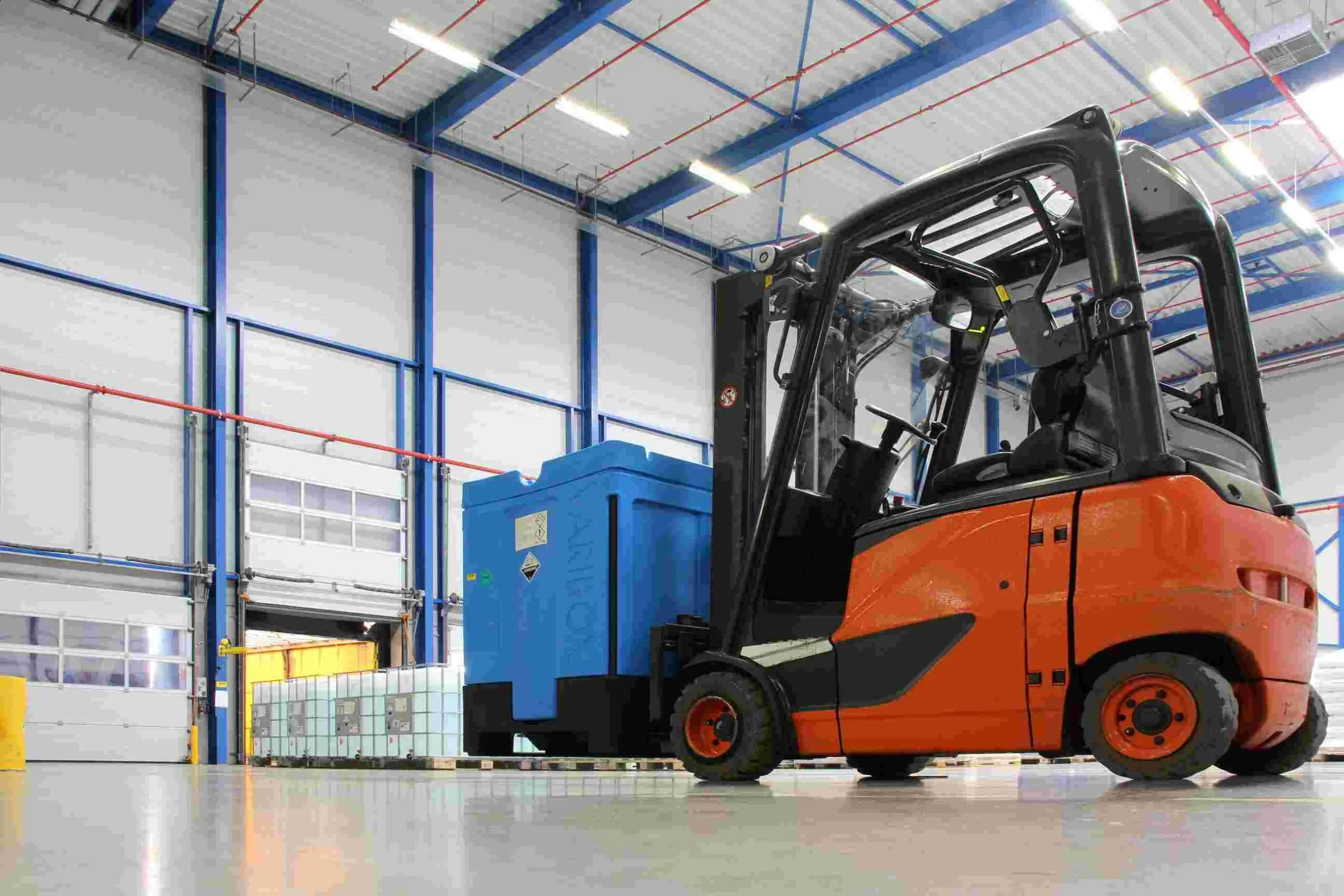
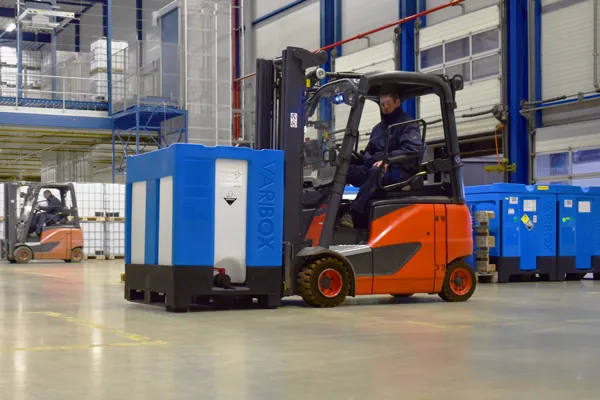
How migration testing works for a reusable IBC
Migration testing under Annex V of Regulation (EU) No 10/2011 uses food simulants standing in for real food categories: simulant B (3% acetic acid) for acidic foods, ethanol 95% and isooctane for fatty/alcoholic foods, and simulant D2 (oil) for fatty foods by immersion. VARIBOX FC has been tested across all four, at a migration ratio of 2.5 dm²/100 ml, under repeated-use conditions at 60°C over 10 days, reflecting the fact that a reusable container, unlike single-use packaging, has to stay compliant across many contact cycles, not just one.
- Simulant B (acetic acid 3%) at 60ºC / 10 days, contact by filling. Repeated use.
- Ethanol 95% at 60ºC / 10 days, contact by filling. Repeated use.
- Isooctane at 20ºC / 10 days, contact by filling. Repeated use. (Test conditions equivalent to migration in vegetable oil, 10 days at 60ºC.)
- Simulant D2 (oil) at 60ºC / 10 days, contact by immersion. Repeated use.
Manufactured, not just tested, to a standard
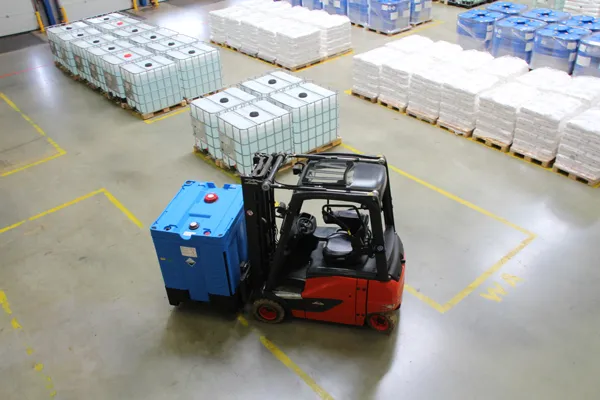
Compliance isn’t only about what the finished container tests as. It’s also about how it’s made. VARIBOX FC is manufactured under Regulation (EC) No 2023/2006 on Good Manufacturing Practice for materials and articles intended to come into contact with food, and the raw materials used comply with Regulation (EU) No 10/2011.
Substances subject to a specific migration limit
A number of substances used in the product carry a Specific Migration Limit (SML) under Annex I of Regulation (EU) No 10/2011. Each is tested and declared individually. Staying under the overall migration limit is not enough on its own if one of these would be present above its SML.
Where food, BPA and PPWR meet, and where they don’t
These are three separate compliance questions that happen to converge on the same container. Food-contact suitability (this page) asks whether the material is safe to touch food, under Regulation (EU) No 10/2011 and Regulation (EC) No 1935/2004. BPA compliance is one specific substance restriction within that same framework, governed by Regulation (EU) 2024/3190. Bisphenol A (CAS 80-05-7) is not used in manufacturing and the VARIBOX FC complies with the restriction accordingly. PPWR is a different legal track entirely: it governs packaging design, recyclability and reuse targets, not what the packaging is made of or whether it’s safe for food. A container can be food-safe and separately need to address PPWR’s reuse and design requirements; the three are assessed independently, even though a single reusable food-grade IBC has to satisfy all of them at once.
Need the Declaration of Compliance for a specific product or lane?
Get in touch with our team for the full declarations on food-contact, BPA and PPWR for your application.
Food contact topics explained
Common questions on food-contact compliance, and where VARIBOX stands on each. Expand any topic for more detail.
Is VARIBOX food-grade certified?
VARIBOX FC with EPDM Food seals meets the relevant requirements of Regulation (EU) No 10/2011 and Article 3, 11(5), 15 and 17 of Regulation (EC) No 1935/2004, both as amended, and complies with Regulation (EU) 2024/3190 on bisphenol A. This compliance can be backed by a Declaration of Compliance which is available on request.
What food contact conditions does the declaration cover?
The product is intended for repeated use, including long-term storage at room temperature or below, heating up to 70°C for up to 2 hours, or heating up to 100°C for up to 15 minutes. Compliance was verified at a food contact surface area to volume ratio of 6 dm²/kg food.
Does VARIBOX use a functional barrier?
No. A functional barrier is not used in this product.
Is this the same declaration as the BPA page, or PPWR readiness?
Related, but not identical. BPA compliance is one specific restriction inside this same food-contact declaration. PPWR reuse and design requirements are a separate regulation entirely, covering packaging design and reuse targets rather than food safety. A VARIBOX FC container can be assessed against all three, but each has its own legal basis and its own documentation.
Does the packer still need to run its own tests?
Possibly, depending on the product. The Declaration of Compliance verifies the packaging against the stated conditions, but a sensory evaluation of the packaged food itself is not performed as part of it, and any influence on organoleptic properties has not been examined. The packer of products is not released from its own responsibilities and may still need to test with the actual packaged product.
Glossary
- Overall migration: the total amount of all substances that transfer from a food-contact material into food, regardless of which individual substances they are.
- SML (Specific Migration Limit): the maximum permitted migration for one individually named substance, set out in Annex I of Regulation (EU) No 10/2011.
- Food simulant: a test liquid (such as acetic acid, ethanol, isooctane, or oil) used to stand in for a category of food during migration testing.
- Functional barrier: a layer placed between packaging material.
- Regulation (EC) No 1935/2004: the EU framework regulation on materials and articles intended to come into contact with food.
- GMP (Good Manufacturing Practice): manufacturing conditions required under Regulation (EC) No 2023/2006 for materials and articles intended for food contact.
- Annex V (Regulation (EU) No 10/2011): sets out the verification of compliance methods, including how migration testing must be performed.
- Annex I (Regulation (EU) No 10/2011): the list of authorised substances and their restrictions, including any Specific Migration Limits.
Do you require a declaration on food contact?
Talk to our team and we’ll supply you with the relevant documentation.
Our VARIBOX Intermediate Bulk Containers
We provide packaging for chemical distribution that excels in safety, reusability, and sustainability.
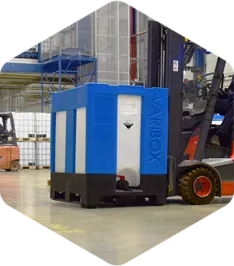
VARIBOX
Single Containment

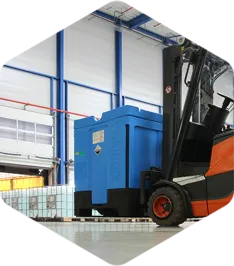
VARIBOX
Full Containment
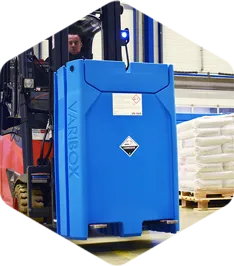
VARIBOX
Compact Containment
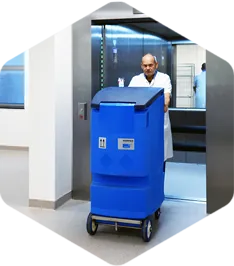
VARIBOX
Drumtainer

Connect+
Full control of your IBC fleet with real time tracking and insights. Pack AI provides an intelligent solution for the reusable packaging industry comprising both hard and software that allows you to achieve maximum control, minimal loss, and a longer lifespan for your IBC fleet.